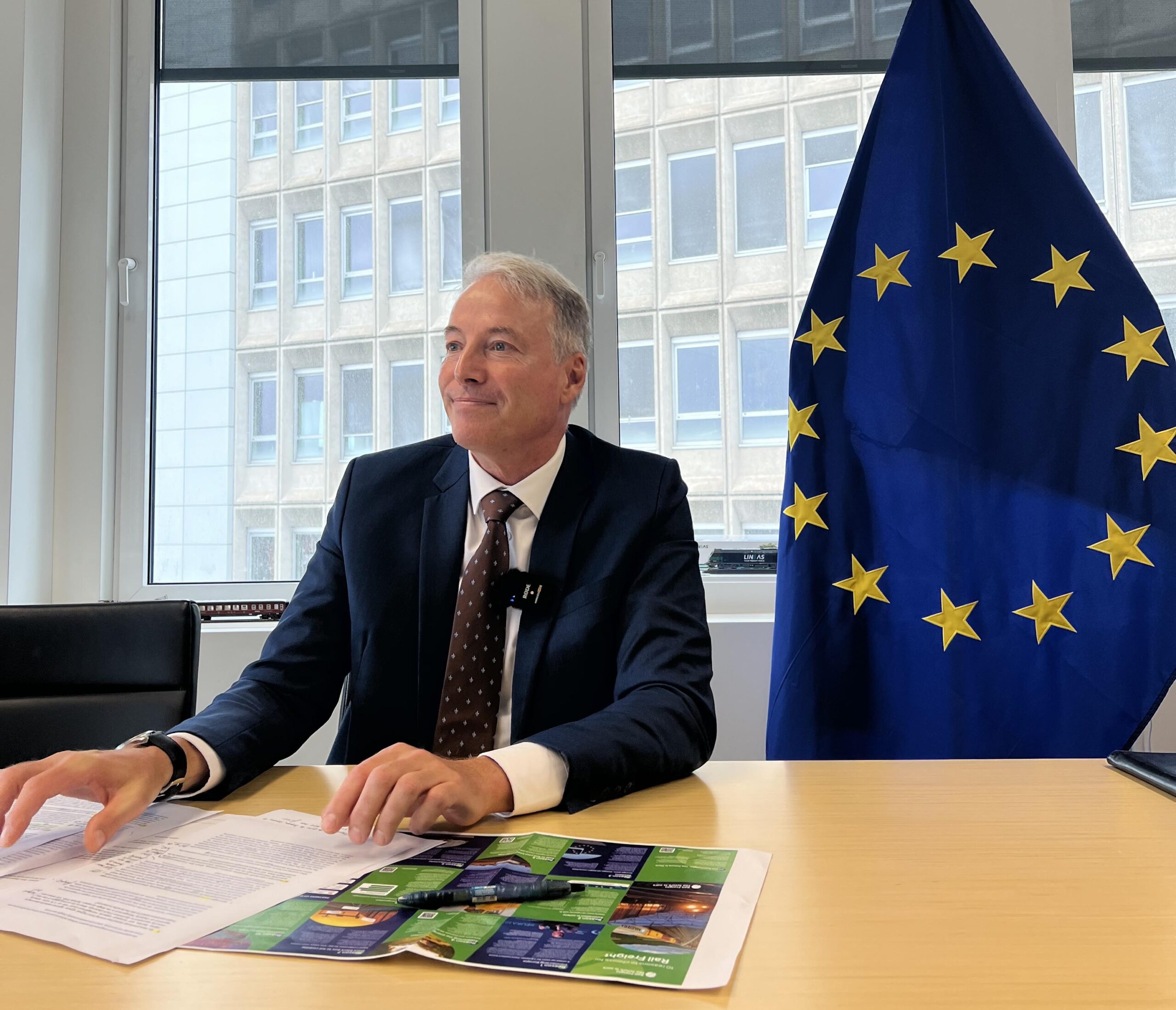
Kristian Schmidt: “Doubling rail freight transport by 2030 is a challenge, but it must be done.”
Rail freight transport is on the eve of a new growth phase. Europe is aiming for a substantial modal shift under the Sustainable and Smart Mobility Strategy, while NATO is calling on member states to invest 1.5% of GDP in resilience. For Kristian Schmidt, Director of Land Transport at the European Commission (DG MOVE), this combination creates both urgency and opportunities: “After decades of neglect, substantial investments are finally being made in rail. This makes rail the logical long-term choice: more efficient, more punctual, and more reliable.”

Ten reasons to choose rail
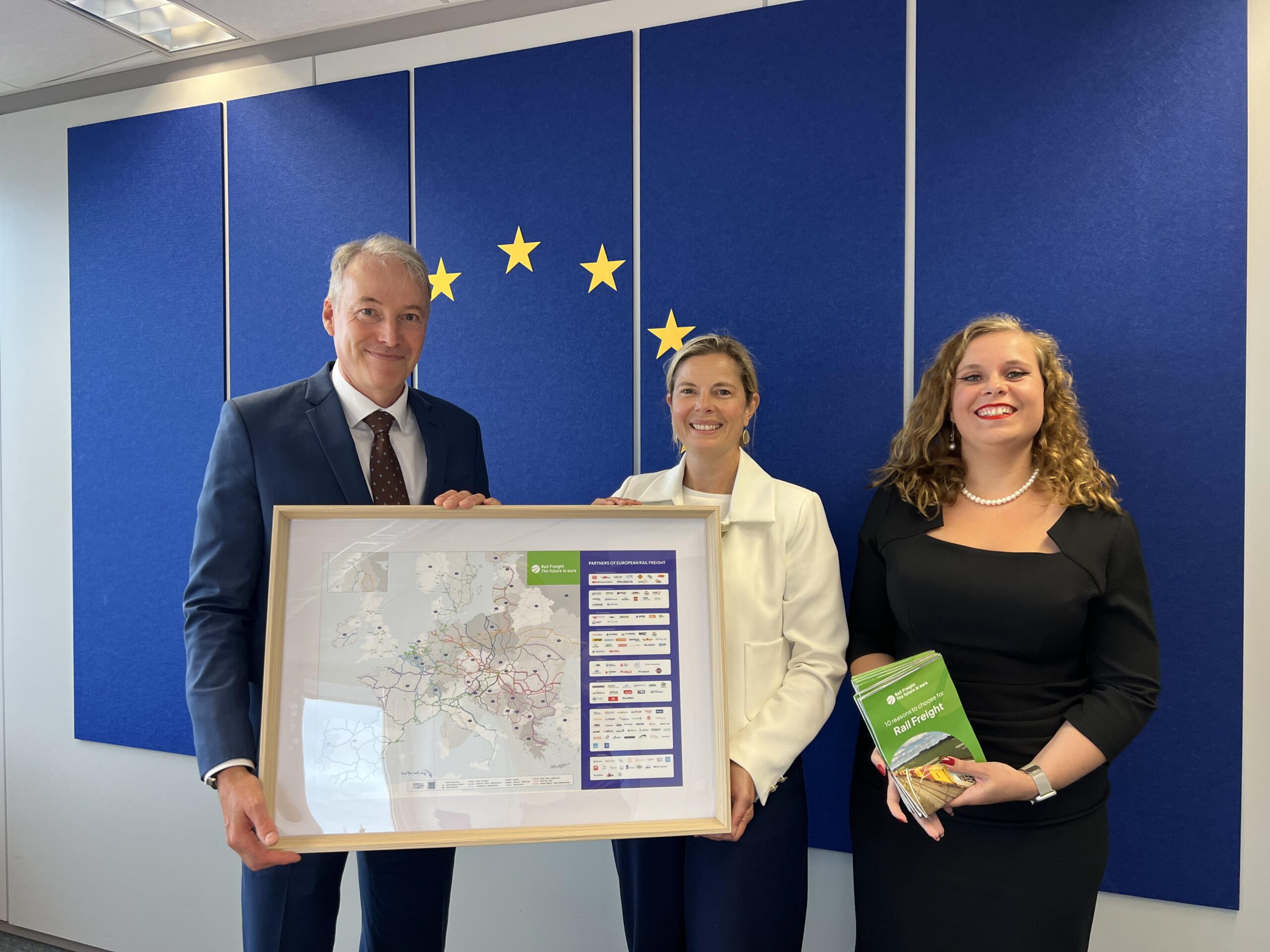
Earlier this year, Rail Cargo Information Netherlands launched the brochure Ten Reasons to Choose Rail Freight during Transport Logistic in Munich. When asked which reasons seem most convincing to him from a customer perspective, Schmidt points to reason 8 – avoiding congestion – and reason 10 – investments in infrastructure.
He brings these together in a clear line of reasoning: fewer trucks on the road means fewer traffic jams, greater energy efficiency, better road safety, and less dependence on drivers. “With rail, you can transport larger volumes over longer distances without those limitations.” He sees the current wave of investment in railway lines, terminals, and digital systems as a sign that reliability and performance are improving. “Today’s inconvenience is tomorrow’s gain.”
Resilience requires redundancy
Digital threats and extreme weather are a daily reality. Schmidt is clear: redundancy is indispensable. “If you depend on a few key corridors, you are vulnerable,” he says, referring to the Rastatt incident that paralyzed the Rhine Corridor for weeks.
According to him, the solution lies in a network with sufficient alternative routes and flexible deployment of capacity, financed in a way that brings together military and civilian interests. Every euro invested in military mobility must also strengthen civilian rail freight transport. Rail operators must see themselves as part of Europe’s broader quest for strategic autonomy.
A European digital backbone
Resilience also requires a secure, independent digital infrastructure. Schmidt calls systems such as ERTMS (European Rail Traffic Management System), FRMCS (Future Railway Mobile Communication System), and robust communication networks crucial. Suppose we did not have Galileo, then we would be dependent on non-European navigation. That would be a strategic vulnerability. Europe must develop its own systems and not be dependent on others.
The same applies to cloud and AI: no single Member State can achieve this alone. The European Commission will soon present a Military Mobility Package, with priorities and legislative changes to accelerate joint implementation. This is a shared file between Transport and Defence, and we work closely together within the Commission.

Investing in corridors and missing links
The European Commission proposes to double the budget of the Connecting Europe Facility (CEF) for transport to €51.5 billion for the period 2028–2034, of which €17.6 billion is for military mobility and resilience. Schmidt sees this as a clear signal of confidence: transport is a top European priority.
CEF funds should primarily be deployed for cross-border missing links, alternative routes required for diversions, and the rollout of digital systems such as ERTMS. Without a strong European impetus, Member States often postpone investments, Schmidt emphasizes. The goal is a network that becomes faster, safer, and more competitive.
Better utilization of capacity
In addition to expanding the network, Schmidt primarily wants to unlock the full potential of the existing infrastructure. There is capacity that remains unused or is not available for cross-border transport, and rail freight transport is one of the biggest victims of this.
Digital, flexible, and European capacity planning can unlock an estimated 4% additional capacity – equivalent to a physical investment of €8.6 billion. The new capacity regulation is nearing completion and enjoys broad support. The benefits will become visible step by step over the coming years. We can only ask taxpayers for more investment if we demonstrate that we are utilizing current capacity efficiently.
Making middle distances more competitive
Over medium distances, where road transport still dominates, the obstacles lie primarily in regulations and operations. Schmidt identifies three levers.
Cross-border train drivers: The Commission is preparing a Train Drivers Regulation to simplify international driving, so that trains do not stop unnecessarily at the border.
Technology: Digital Automatic Couplings (DAC) are crucial, especially for single wagonloads. Without a DAC, this segment is barely viable. Thanks to European support, the first pilot trains are now running.
Intermodality: Rail can rarely provide a complete door-to-door chain and must therefore connect efficiently with other modalities. This requires modernized inland terminals, better port-rail connections, and smoother transshipment between truck and train. Rail wins when it seamlessly connects to the broader logistics system.
New growth markets for rail
Traditional bulk flows such as coal and iron ore are declining due to the energy transition. Growth is emerging elsewhere. Schmidt sees opportunities in container transport, intermodal flows, and semi-trailers on rail. As production processes increasingly operate on a just-in-time basis, the demand for flexible and reliable services is growing—an area where rail can distinguish itself.
In addition, the circular economy will generate new flows of goods. The recycling of batteries and the recovery of critical raw materials take place in specialized facilities that are not present in every country. This creates cross-border flows for which rail is the sustainable and scalable option. A potential reindustrialization of Europe in strategic sectors can also provide rail with additional volume.
On the way to 2030
The objective is clear: rail freight transport must double by 2030. The starting position is less favorable: the modal split is stagnating, intermodal transport is growing, but bulk transport is declining.
Schmidt sees four pillars that must bring progress:
- structural investments by Member States,
- a level playing field via ETS in which road transport is taxed fairly,
- more efficient operations through digital innovations and the removal of border barriers,
- and a competitive European economy as a foundation.
“For passenger transport, I am convinced that we will meet the targets. For freight transport, we still have to work very hard in the coming years. But if the reforms succeed, we can achieve the doubling. It must be done: for climate neutrality, strategic autonomy, and the competitiveness of Europe.”
About Kristian Schmidt
Kristian Schmidt has been Director of Land Transport at the European Commission (DG MOVE) since April 2021. He leads Directorate C, which focuses on greener, smarter, and more resilient transport in Europe, with an emphasis on cross-border rail, interoperability, digitalisation, and sustainable logistics.
Previously, he served as EU Ambassador to Myanmar and Uganda and as Director at DG DEVCO. Prior to that, he worked at the Danish Ministry of Foreign Affairs and at the United Nations in New York. Schmidt studied economics in Copenhagen and Aix-en-Provence and pursued additional studies in Paris, Bologna, and Cambridge.
Stay informed
Stay updated on all our events, news, and updates. Sign up for the monthly Rail News(letter).