Jürgen Albersmann on key developments in intermodal transport in Europe
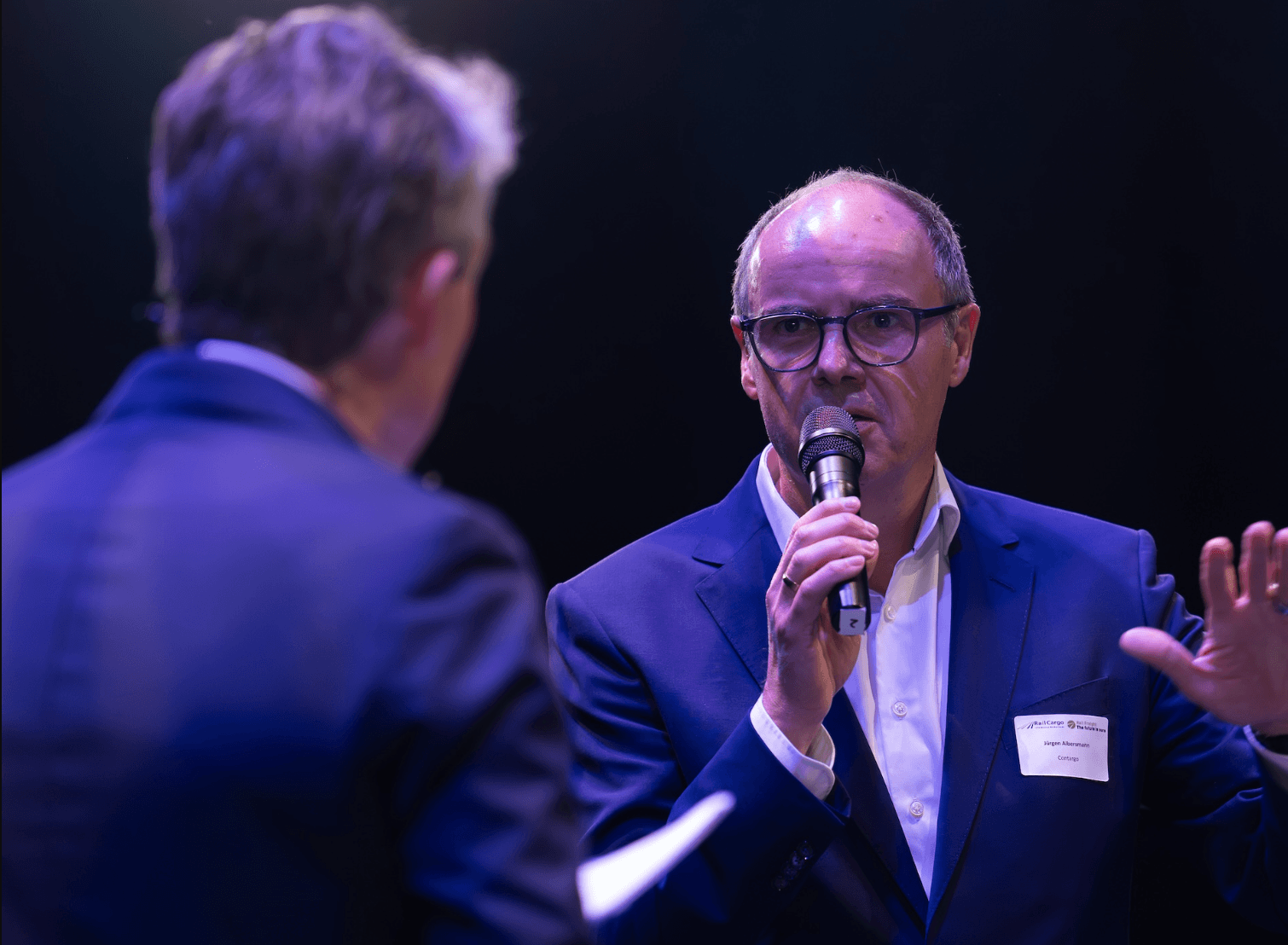
What will shape intermodal transport in Europe over the coming years? During the Rail Freight Conference 2026, Jürgen Albersmann, CEO of Contargo and Chairman of UIRR, provided a clear and pragmatic perspective on current developments in the sector. His contribution focused less on growth or ambition, and more on how the system can remain operational in an increasingly unpredictable environment.
From sustainable growth to resilience
According to Albersmann, the sector’s focus is shifting from growth and sustainability towards resilience. This shift is visible at multiple levels: in policy, in investment strategies, and in the way companies organise their networks. For Contargo, this led to the explicit inclusion of resilience as a strategic pillar in 2022.
This strategy translates into three concrete choices. First, the company is investing in its own assets, such as terminals, wagons and other transport equipment. This reduces dependency on external parties and increases control over operations. Second, the planning model is evolving. Contargo is moving from a decentralised structure towards centralised planning, where flows across road, inland waterways and rail are jointly coordinated and optimised. The third pillar is collaboration — not as a general principle, but as a practical necessity to deal with disruptions, infrastructure works and capacity constraints.
This focus on collaboration aligns with the role of UIRR, the European association for combined transport. A significant share of intermodal transport is cross-border, making national solutions insufficient. Decisions on capacity, regulation and framework conditions are largely taken at European level. At the same time, priorities are shifting. Where sustainability previously dominated the agenda, the stability of the system and the resilience of the industrial base are now gaining importance.

Infrastructure, disruptions and increasing competition
A substantial part of the keynote addressed the situation in Germany. Significant investments are planned in the rail network, but these come with prolonged closures of key corridors. For freight transport, this results in detours, additional kilometres and rising costs. In some cases, services cannot operate at all.
According to Albersmann, this directly affects the reliability of rail as a logistics solution. Shippers primarily value predictability and continuity. When these are under pressure, rail becomes less attractive. In combination with developments around the Betuweroute, he underlined the importance of cross-border coordination. The European rail network functions as a single system, while infrastructure planning is still largely organised at national level. Works in one country have immediate consequences for the rest of the network. Better coordination is therefore not just a policy issue, but an operational necessity.
Jürgen van Heemst (Ministry of Infrastructure and Water Management) added that the Netherlands is proactively strengthening cooperation with Germany:
“Together with ProRail and the sector, we are working on smarter planning of infrastructure works to minimise the impact on rail freight. We are doing this in close coordination with Germany, to better align projects and keep the network operational.” – Jürgen van Heemst

At the same time, the nature of freight flows is changing. Traditional bulk volumes are declining, while containerised and intermodal transport is becoming more important. This requires different network choices: more terminals, better data and information exchange, and stronger integration between modes. At the same time, competition is evolving. Electric road transport is developing rapidly and is becoming increasingly competitive, particularly over medium distances and in domestic transport.
“Battery-electric trucks are becoming a serious alternative on medium and domestic distances. If rail is to remain the winning mode over the next 10 to 15 years, we need to significantly improve both our network and our quality.” – Jürgen Albersmann
The core of Albersmann’s message is clear. Rail freight in Europe has strong potential for further growth, but this is not guaranteed. The coming years will require better planning, sharper choices and stronger collaboration — across companies, modes and national borders.
Stay informed
Stay updated on all our events, news, and updates. Sign up for the monthly Rail News(letter).